

Guide to Free Hebrew Resources
How do I figure out what the original text is saying?
When people find out I know Biblical Hebrew, one common follow-up question is, “what Bible translation do you use?” I don’t really like answering that question, because I think it’s a little bit besides the point. It’s like asking what the best chocolate chip cookie recipe is. People have different preferences, and different access to ingredients. So, the question I want to address is, “How do I know what the original text is actually saying?”
The following are free resources, with tips on how I would use them if I were first starting out on the journey of studying Hebrew Bible.
Dictionaries and Lexicons
Brown Drivers Briggs (BDB)
When you click through a Hebrew word in a free online interlinear, you’ll usually land on the BDB entry page for that word. They’re categorized by Strong’s numbers, which is an index of all the words that occur in the Hebrew Bible.
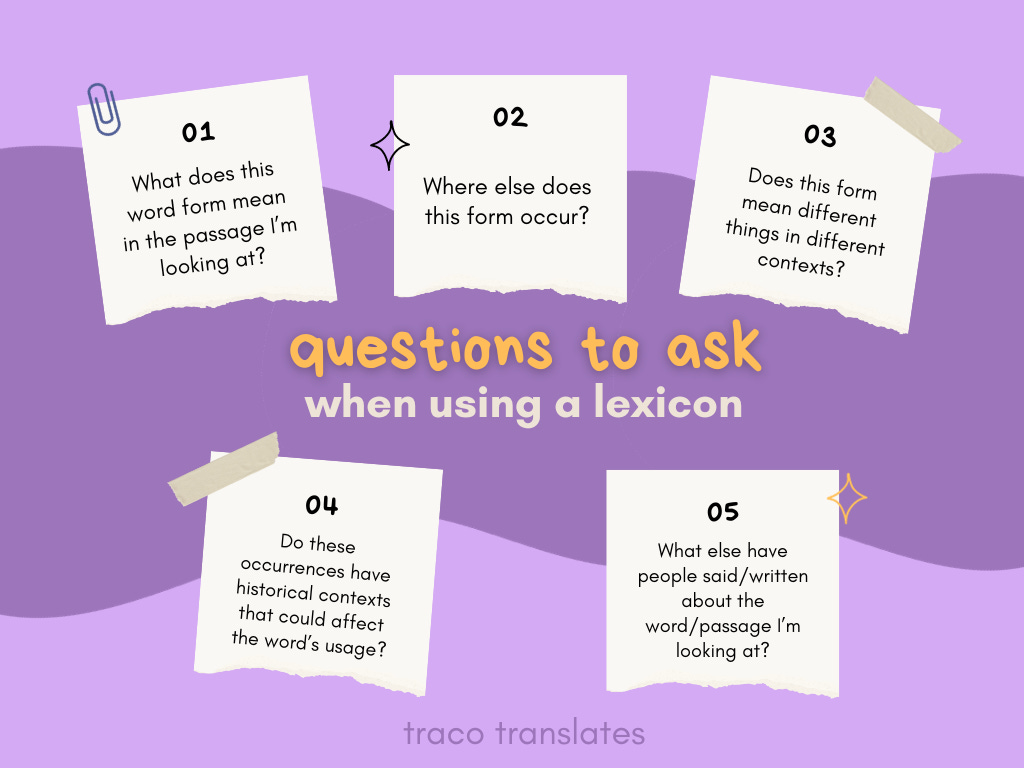
BDB is ubiquitous and has been for a while, as it was written and compiled before many other manuscripts (including the Dead Sea Scrolls) were discovered. The entries are generally helpful, but some entries are very speculative because the authors just didn’t have enough data to base their entries off of. For example, I recently worked on Deuteronomy 14, and no one really knows which birds are in the passage, with wildly different glosses in BDB, HALOT, and between the Samaritan Pentateuch and Septuagint (Greek Old Testament).
Best way to use BDB:
To find out how a specific Hebrew word form is used in other passages
As a starting place for cross-referencing (a lot of the references are German works, but you may be able to find entries on wiktionary.org that contain similar information)
With lots of fact-checking (a brief google will usually suffice - someone else has probably argued about the thing you’re looking into on some forum with plenty of sources)
How not to use BDB:
Don’t use BDB to figure out what something doesn’t mean or doesn’t say. Have you ever heard the claim that “there’s no word for coincidence in the Hebrew Bible”? That’s like saying a toddler who sees a tiger but hasn’t learned the word for it doesn’t know what a tiger is. Just because there’s no attestation of a word doesn’t mean the concept didn’t exist in the culture.
Don’t use BDB with the starting assumption that the Bible translation that you’re referencing is ‘inaccurate’
Don’t use BDB to draw conclusions about one word form from another form. As in, don’t look at the entry for love and make conclusions about a derivation, like caused to love. Different word forms do different things.
Don’t assume that a word’s etymology (or related words) are relevant to its meaning. For example, December comes from deca, meaning ten, but December is not the tenth month. Etymology is not destiny.
HALOT
The version linked here is the online scanned copy on archive.org. It’s harder to navigate, but HALOT is a lot more updated and reliable than BDB. I get a lot of ideas for research directions from HALOT entries.
How to use HALOT
To double-check information from BDB
To see how Biblical Hebrew words are related to other semitic languages
Chapter and Verse
Interlinears
I personally don’t think interlinears are that helpful. They pretty much only tell you what Hebrew word is being translated into which English (or other language’s) words. In general, I would not recommend them.
Hebrew grammar
How to use a Hebrew grammar:
For the more serious and committed reader: treat it like a textbook. Take notes. Make flashcards. Do the exercises. It’s language learning, and it takes a whole lot of hours (and consistency!) to get anywhere.
For the casual, low-commitment reader: look up certain features as you come across them. For example, looking up singular vs. plural forms of a word that comes up often in a certain passage (like hill/hills in much of the Pentateuch).
Commentaries
Out of all of these resources, I think commentaries are the most accessible for the layperson. But, that’s because commentaries tell you what to think. Sometimes that’s helpful. Sometimes it’s not. I’ve read many a commentary that makes claims that are simply not true.
How to use a commentary:
Know what exactly you want the commentary to do. Are you looking for help with interpretation? Are you looking for historical context? Many biblical scholars spend years on just one book. A random scholar’s commentary on one book may be more helpful than the same from a more well-known person.
Research the author and note their strengths and weaknesses. For example, I would trust an archaeologist’s historical information, but maybe not their theological interpretation.
If you don’t have time to double-check all the claims, assume that the claims are unconfirmed. Biblical scholars will go back and forth arguing over the smallest things, both sides with credible evidence. A convincing argument from one commentator isn’t empirical truth.
Conclusion
Not everyone has the time or opportunity to become a Hebrew scholar, but anyone can fact-check what they hear or read. Hopefully these resources can help you answer questions for yourself. I’ll post more in the future about my personal research process and introduce even more tools that are available for free.