

Quickie: Translating Poetry
If it doesn't rhyme, it's a waste of time
When you translate an idiom like “It’s raining cats and dogs” into a language that doesn’t have that image, what do you do? If you say, “It’s raining a lot,” the final text feels different. You could use a similar idiom from the target language, but that’s also not the same.
Then, to add even more confounding variables, every genre has specific features in every culture. Take a specific genre, like poetry. How can you translate poetry into English without being influenced by Shakespeare? For example, take the children’s nursery rhyme, Frère Jacques.
Frère Jacques, Frère Jacques,
Dormez-vous? Dormez-vous?
Sonnez les matines! Sonnez les matines!
Din, din, don. Din, din, don.
Then, the most common English version:
Are you sleeping? Are you sleeping?
Brother John, Brother John,
Morning bells are ringing! Morning bells are ringing!
Ding, dang, dong. Ding, dang, dong.
The syllables and the beats match, which makes sense for a children’s song. It needs to be catchy, simple, and memorable. In this, the English translation excels.
But, if you evaluate the English translation by other metrics, it falls short. For one, the English version doesn’t exactly stay faithful to the meaning of the original. In the French, Friar Jacques must ring the morning bells. Here’s where the English is ‘wrong.’ In the English version, the bells awaken Brother John.
For our purposes, the most interesting change is that the English version rhymes. Well, it doesn’t fully rhyme, but it rhymes much more than the original. SleepING rhymes with ringING; JOHN rhymes with DONG.
Again, how can you translate poetry into English without being influenced by Shakespeare (or the English canon at large)? Rhyme and meter are both extremely important in the history of English poetry, and this affects how translators approach poetry.
Is it really poetry if it doesn’t rhyme?
One of the greatest obstacles in translating poetry is that it’s impossible to match the rhyming in the original while maintaining the same meaning. For some cultures, such as English, this makes it very hard for a piece to register as poetry, especially if it’s an older, more formal work.
For one, Psalm 23, oft-cited in lists of ‘Best Poems of All Time,’ doesn’t rhyme. It doesn’t even rhyme in the original language. So how do we know if it’s poetry or not? What if it’s just flowery prose that we segmented into lines and labeled as poetry?
There are extremists who essentially believe that there’s no poetry in Biblical Hebrew.1 However, most scholars agree that Hebrew poetry is poetry because it has, to some degree, some form of meter.
What if there’s no meter?
The problem we face is that Hebrew meter is very difficult to identify. Some say it’s syllables, others say it’s entire words.2 We’re still figuring it out. A lot of the times, though, the line between prose and poetry is quite blurry. No, Rilke and Kafka did not invent prose poetry. They had it in the late bronze age too!
But, for those that believe that Hebrew poetry does not have meter, they claim that the only feature that distinguishes Hebrew poetry as poetry is its parallelism.
So, how do you translate poetry?
Well, you translate it carefully. It’s an art. Consider this translation of Psalm 23 by a fellow Semiticist I’ve followed for some years:
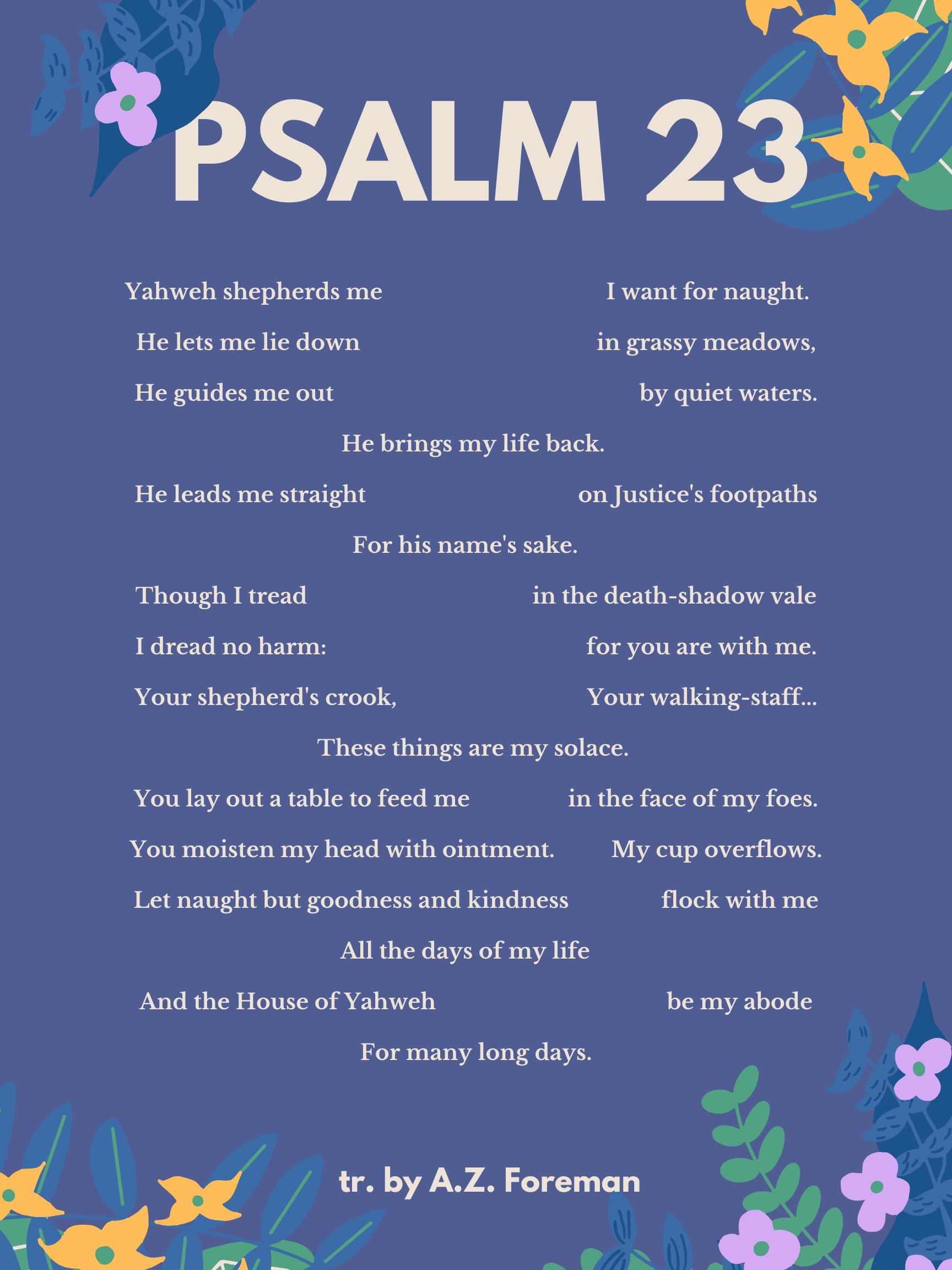
Not exactly the KJV, right? But it’s beautiful and masterfully crafted, isn’t it? You translate poetry by making sure the end result is beautiful. That’s the beginning and end of it.
Alter, Robert. The Art of Biblical Poetry. New York: Basic Books, 1985.
Isaacs, Elcanon. “The Metrical Basis of Hebrew Poetry.” The American Journal of Semitic Languages and Literatures 35 (October 1, 1918): 20–54.