

Idiom of the Week #5: Tear open your eyes with black paint
Never ask a girl with winged eyeliner why she is late
I have followed internet beauty gurus since high school. At that time, names like James Charles, Jeffree Star, and Nikkie tutorials, were ubiquitous. Rihanna launched Fenty. Everyone wanted a Kylie lip kit. If you remember the makeup of the 2010s, you'll remember overlined lips, heavy highlighter, severe brows, and face-morphing contour.
Makeup used to be much simpler. In fact, you could get away with just eyeliner in ancient times. Our oldest examples of cosmetics come from the Egyptians. The most popular example is kohl, a (usually) black substance (wax or powder; archaeologists have found many different formulas) used to enhance one's eyes. Men and women alike wore kohl. The Egyptians believed kohl had medicinal benefits (and therefore a ritual purpose), such as anti-bacterial effects and protecting eyes from glare (like football players). They were even buried with jars of kohl.1
We see these ancient examples of cosmetics even in the Hebrew Bible. For example, Esther undergoes a whole twelve months of spa days before the Persian court deems her worthy of meeting the king. Other times, beauty is associated with less savory roles. These beauty faux pas are what we will investigate today.
Jerusalem's prostitution
One example of indecent makeup occurs in Jeremiah. Jeremiah was a prophet at the end of Judah's existence before she went into captivity under Babylon. He denounces the sins of Israel and the sins of the surrounding nations. With stirring rhetoric, he grieves for the punishment to come.
In Jeremiah 4, the prophet guarantees the complete ruin of Jerusalem. He writes of the city as a devastated woman, an unwanted prostitute dressing up for nothing:
What are you doing, you devastated one?
Why dress yourself in scarlet
and put on jewels of gold?
Why highlight your eyes with makeup?
You adorn yourself in vain.
Your lovers despise you;
they want to kill you.
Jeremiah 4:30
The rhetorical questions highlight the futility of Israel's situation, What's the point? Then, we have parallel versets where the second verset intensifies the first.
A: Why dress yourself in scarlet
B: and put on jewels of gold?
Scarlet fabric was expensive, and gold was even more expensive. Verset B escalates verset A. The prophet mocks Jerusalem for wasting these luxuries, for her adornments cannot redeem her.
A: Your lovers despise you;
B: they want to kill you.
Not only do Jerusalem's lovers reject her, they even hate her to the point of killing her. Again, verset B intensifies verset A. The poetic devices emphasize the utter humiliation that Jerusalem is undergoing and will further undergo.
Eyeliner is not just for emos!
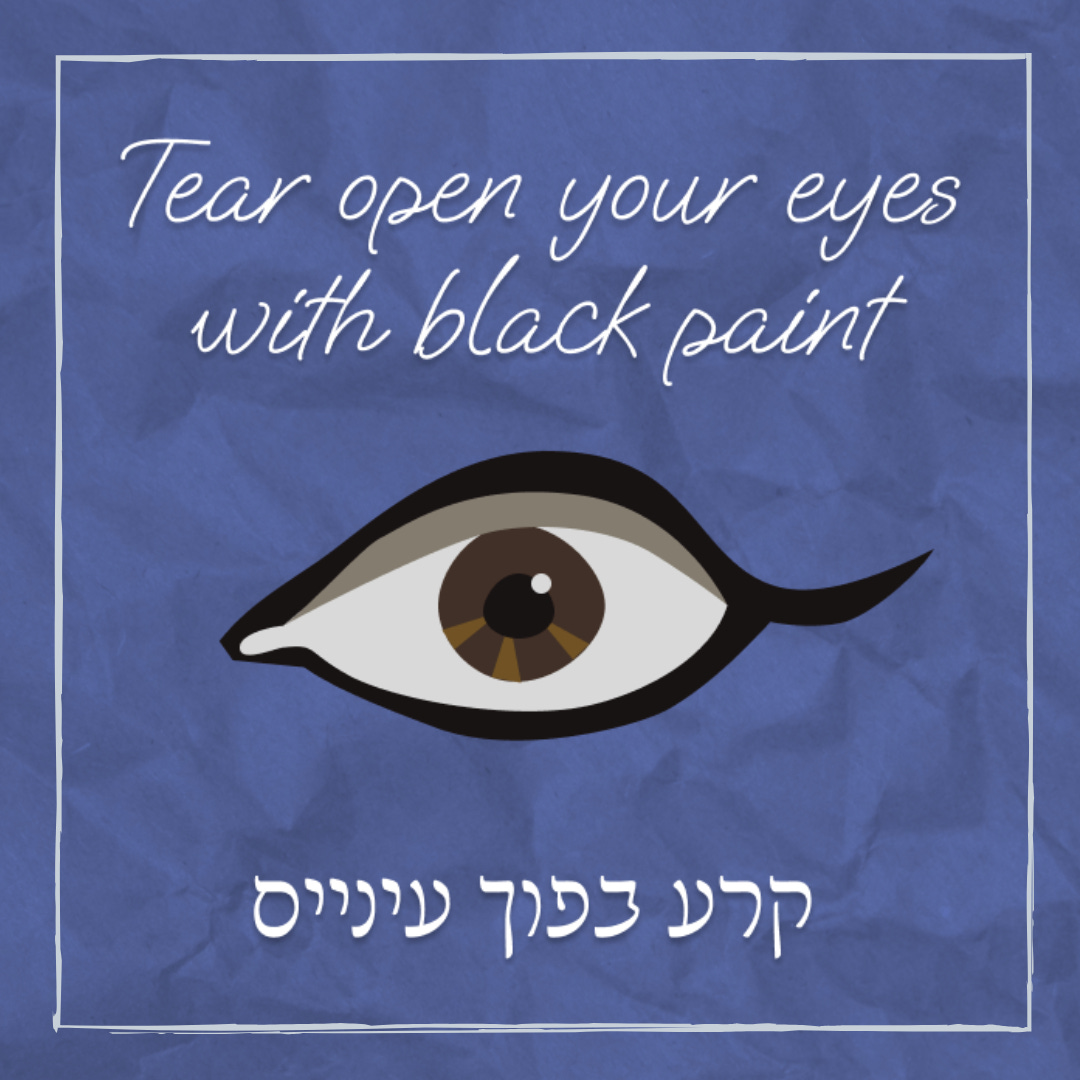
Now, we focus on the idiom, “highlight your eyes with makeup.” Some translations say, “enlarge your eyes with makeup.” A more direct translation might say, "tear your eyes open with black paint."
תִקְרְעִ֤י בַפּוּךְ֙ עֵינַ֔יִךְ
ṯiqrꜥi ḇappûḵ ꜥênayiḵ
You (female) tear open with black paint your eyes
The Hebrew word for eyeliner, puch, most likely refers to kohl. It is related to the Syriac verb that means “to crush,” and the Arabic word for “to cut up.” Thus, we infer that eyeliner was made from crushed black minerals.2
The act of putting on eyeliner is likened to violent disfiguration. The prostitute carves away her eyelids with black paint to give herself bigger eyes. She will do anything to be attractive. She will do anything to whore herself out so that her lovers might save her from the coming destruction.
The prophet views her makeup as a mortician's trick—dressing up a corpse. Jerusalem is vain and trusts in her beauty too much. She commits self-violence to enlarge her eyes in a futile attempt to attract a lover. And she doesn't just forsake her covenantal partner but also pursues the pagan customs of her lovers. Indeed, kohl is from Egypt, and Yahweh wants Jerusalem to have nothing to do with the rituals of Egypt.
In Jeremiah’s view, eyeliner represents prostitution, which represents sin. He is not saying that eyeliner is inherently immoral. Rather, makeup symbolizes Jerusalem’s self-sabotage, and eyeliner is, metaphorically, her hubris.
Issa Tapsoba et al., “Finding Out Egyptian Gods’ Secret Using Analytical Chemistry: Biomedical Properties of Egyptian Black Makeup Revealed by Amperometry at Single Cells,” Analytical Chemistry 82, no. 2 (January 15, 2010): 457–60, https://doi.org/10.1021/ac902348g.